Chest Disease Treatments
Breathe Better with Chennai's Most Trusted Chest Specialist
If every breath feels like an effort — or if a nagging cough, persistent wheeze, or inexplicable tightness in your chest has been stealing your peace — you deserve more than guesswork. At Asthma & Diabetes Studio, our dedicated chest specialist in Chennai, Dr V. Devanathan, brings advanced lung and respiratory care expertise to help you breathe with confidence again.

Is Your Chest Trying to Tell You Something?
Most people dismiss chest and breathing symptoms as stress, acidity, or seasonal allergies — and in doing so, allow a correctable condition to quietly progress. A general physician manages a broad spectrum of health concerns; a chest specialist is trained to detect, diagnose, and treat the full complexity of pulmonary and respiratory disease with precision. Do not wait until symptoms are severe.
Consult a chest specialist if you experience:

Breathlessness on minimal exertion or at rest

Chronic cough lasting more than three weeks

Unexplained wheezing or chest tightness

Recurring chest infections or pneumonia

Persistent fatigue linked to poor sleep or snoring

Coughing up blood or discoloured sputum

Meet Our Chest Specialist
Dr V. Devanathan, MBBS, MD (PULMONOLOGY), CCEBDM CMH ( University of Washington ) Pulmonologist
Dr V. Devanathan, MBBS, MD (Pulmonary Medicine), is a consultant pulmonologist whose clinical philosophy is rooted in attentive, evidence-based care. A postgraduate of the prestigious Stanley Medical College and Government Hospital of Thoracic Medicine (GHTM), Tambaram, he brings over 12 years of broad medical experience, including 6 years of dedicated specialist practice in respiratory medicine. His particular areas of clinical focus are asthma and tuberculosis, including complex drug-resistant TB (MDR and XDR).
Academic & Professional Standing:
- Assistant Professor, Department of Pulmonology — Stanley Medical College & GHTM, Tambaram
- Nodal Officer for Drug-Resistant TB, GHTM — a designated Centre of Excellence for DRTB
- Advanced training: Clinical HIV Management, University of Washington; CME, Harvard Medical School
- Member — Indian Chest Society (ICS), American College of Chest Physicians (ACCP), European Respiratory Society (ERS), Indian Medical Association (IMA)
Chest & Lung Conditions We Treat
From common obstructive conditions to rare and complex pulmonary disorders, our practice offers comprehensive, specialist-led management across the full spectrum of chest and respiratory disease. Whether your condition is longstanding or newly diagnosed, every patient receives a structured, evidence-guided treatment plan.
How We Diagnose & Treat Chest Conditions
Accurate diagnosis is the cornerstone of effective pulmonary management. Our clinic is equipped with an advanced battery of diagnostic tools, enabling comprehensive evaluation without requiring multiple referrals.
Pulmonary Function Tests (PFT)
Quantitative assessment of lung volumes, capacities, and airflow to identify obstructive or restrictive patterns.
Spirometry
Gold-standard measurement of forced vital capacity and airflow dynamics, essential for asthma and COPD staging.
Airway Oscillometry & FOT (Forced Oscillation Technique)
A non-effort-dependent method to evaluate small airway resistance, particularly valuable in paediatric and elderly patients.
Allergy Testing — FeNO (Fractional Exhaled Nitric Oxide)
A validated biomarker for eosinophilic airway inflammation, guiding steroid responsiveness.
Skin Prick Tests & Serum IgE Levels
Identification of specific allergen sensitisation to direct targeted immunological management.
Pulse Oximetry & 6-Minute Walk Test
Functional cardiorespiratory assessment to evaluate exercise tolerance and oxygen desaturation.
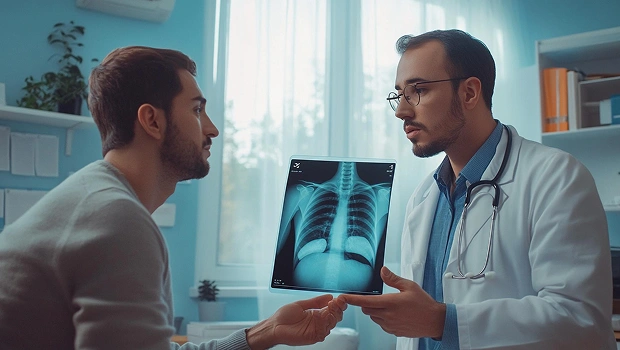
Chest X-Ray & CT Chest Review
Radiological interpretation for structural pulmonary pathology, malignancy screening, and infection localisation.
Sleep Study Interpretation (Polysomnography / Apnoea Screening)
Comprehensive evaluation of sleep architecture and nocturnal respiratory events.
Free TB Diagnostic Test (GeneXpert) & Free Treatment
Complimentary molecular TB diagnostics and fully-funded pharmacological treatment for eligible TB patients for the complete 6-month course.
Why Patients Trust Our Chest Specialist in Chennai
Trust in a physician is earned through clinical outcomes, not credentials alone. Patients choose Dr V. Devanathan because he combines deep, specialist-level expertise — in both common presentations and diagnostically complex pulmonary cases — with a consistently personalised, unhurried approach to care.
- Subspecialty depth across obstructive, infective, allergic, and sleep-related respiratory conditions
- Comprehensive diagnostics under one roof — no fragmented referrals
- Individualised treatment protocols — evidence-based, not templated
- A listening-first consultation — patients feel genuinely heard, not processed

Medically Reviewed by
Dr. V. Devanathan – Pulmonologist
MBBS, MD (PULMONOLOGY), CCEBDM CMH ( University of Washington )12+ Years of Experience in pulmonology and respiratory medicine